 By Bob Paterson
Human composting is not yet legally authorized in Illinois. Human composting, formally known as natural organic reduction, is a process that transforms a deceased human body into soil through controlled decomposition using organic materials, air, heat, and time. Illinois lawmakers introduced legislation in 2026 that would create a licensing system for natural organic reduction facilities, but as of September 2026, that proposal has not completed the legislative process. Illinois therefore does not currently have a legal framework allowing funeral homes or other facilities to perform human composting within the state.
What Does Illinois Law Say About Human Composting?
Illinois law currently regulates established forms of disposition such as burial and cremation.
The state’s Crematory Regulation Act, 410 ILCS 18, defines cremation as a process using either heat and flame or alkaline hydrolysis to reduce human remains to bone fragments. Natural organic reduction is not included within that definition.
Illinois’s Disposition of Remains Act establishes who has authority to make decisions about a deceased person’s remains and recognizes disposition arrangements, including cremation. However, Illinois has not yet enacted a statute establishing natural organic reduction as a separately licensed method of disposition.
As a result, a funeral home or other company cannot simply begin offering human composting services in Illinois without a legal licensing and regulatory system authorizing the process.
What Is Natural Organic Reduction?
Natural organic reduction is an alternative to conventional burial and cremation.
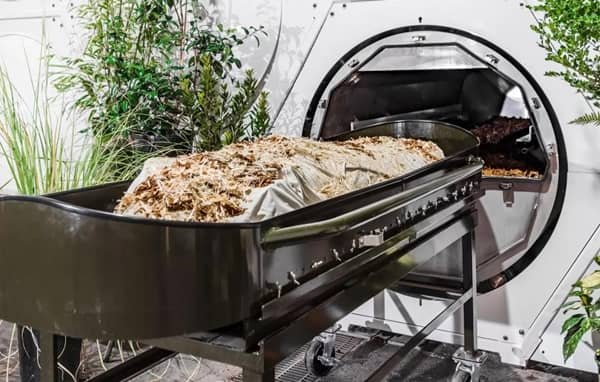
The process generally places a deceased person’s body in a controlled vessel with organic materials such as wood chips, straw, or similar plant materials. Airflow, moisture, temperature, and microbial activity accelerate natural decomposition until the remains are converted into soil-like material.
Illinois’s proposed Natural Organic Reduction Regulation Act describes the process as transforming a human body into soil using natural decomposition accelerated through the addition of organic materials.
Human composting is therefore different from burial, flame cremation, and alkaline hydrolysis.
Has Illinois Tried to Legalize Human Composting?
Yes.
In February 2026, lawmakers introduced House Bill 5425, which would create the Natural Organic Reduction Regulation Act.
The proposal would allow appropriately licensed cemeteries, funeral establishments, businesses, and other qualifying entities to operate natural organic reduction facilities in Illinois. It also establishes requirements concerning licensing, authorization, handling of remains, recordkeeping, facility procedures, safety, and the final disposition of reduced remains.
The Illinois House passed HB 5425 on April 17, 2026, by a vote of 64-36. The bill then moved to the Illinois Senate and was referred to the Senate Assignments Committee on April 21, 2026. The official legislative record still shows that as its status.
Therefore, the proposal has not become an Illinois Public Act and has not legalized human composting.
The bill originally contained an effective date of June 1, 2026, but an effective date written into a proposed bill has no legal effect unless the bill actually completes the legislative process and becomes law.
How Would Human Composting Work Under the Proposed Illinois Law?
If HB 5425 eventually becomes law in its current or similar form, human composting would be tightly regulated.
The proposal would require natural organic reduction to occur only at a properly licensed facility. Facilities would need systems for identifying and tracking human remains throughout the entire process.
The House amendment also requires a reduction chamber to reach at least 131 degrees Fahrenheit for 72 consecutive hours as part of the process for destroying human pathogens.
The proposed law also contains restrictions involving certain hazardous implants, infectious conditions, embalmed remains, and other circumstances that may make natural organic reduction unsuitable.
After completion, the resulting reduced remains could generally be placed in a grave, crypt, or niche or scattered in locations permitted by the proposed statute.
These rules illustrate why human composting cannot currently operate simply as an unregulated form of ordinary composting.
Is Alkaline Hydrolysis Legal in Illinois?
Yes. Illinois law already recognizes alkaline hydrolysis as a form of cremation.
Sometimes called water cremation or aquamation, alkaline hydrolysis uses water, alkaline chemicals, heat, and pressure rather than flames to break down human remains.
Illinois’s Crematory Regulation Act expressly includes alkaline hydrolysis within its statutory definition of cremation.
This means someone seeking an alternative to traditional flame cremation may have an option that is already recognized under Illinois law.
However, alkaline hydrolysis and human composting are completely different processes. Legalization of one does not automatically legalize the other.
Can You Compost a Human Body at Home in Illinois?
No legal Illinois framework currently allows families to conduct human composting themselves at home.
Human remains are subject to state laws concerning death certificates, disposition permits, funeral practices, cremation, burial, and handling of deceased bodies. The proposed legislation itself would require natural organic reduction to take place at a licensed facility rather than through an informal home-composting process.
Therefore, ordinary backyard or home composting of human remains should not be treated as a lawful alternative to burial or authorized cremation.
Could Human Composting Become Legal in Illinois?
Yes, it could.
HB 5425 demonstrates significant legislative interest in authorizing natural organic reduction. The measure has already passed the Illinois House.
However, the Illinois Senate would still need to act on the proposal, and it would have to complete the remaining legislative process before becoming law.
Until that occurs, the current position remains straightforward: Illinois has not legalized or licensed human composting as an in-state method of human disposition.
Frequently Asked Questions
Q1. Is human composting currently legal in Illinois?
No. Illinois does not currently have a law authorizing licensed natural organic reduction facilities to compost human remains within the state.
Q2. Did Illinois legalize human composting in 2026?
No. The Illinois House passed HB 5425 in April 2026, but the bill has not completed passage through the Senate and has not become law.
Q3. Is water cremation legal in Illinois?
Yes. Illinois law recognizes alkaline hydrolysis, commonly called water cremation or aquamation, within its legal definition of cremation.
Q4. Can you compost a family member’s body on private property in Illinois?
No current Illinois law creates a home-composting exception for human remains. Human disposition must comply with Illinois death, burial, cremation, and related funeral laws, and the proposed natural organic reduction legislation would require the process to occur through licensed facilities.