 By Patricia Jones
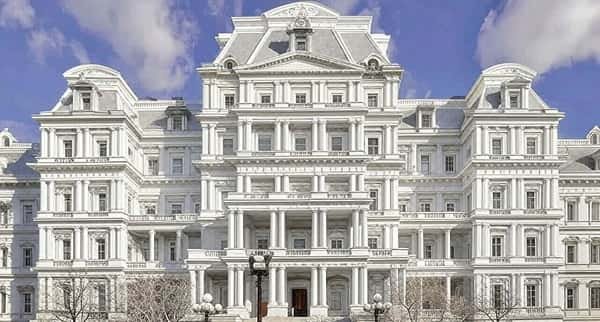
 The Eisenhower Building preservation lawsuit concerns the Trump administration’s plan to paint the historic Eisenhower Executive Office Building white. Preservation groups argue that the project could permanently damage the building’s granite exterior and should not proceed without the environmental and historic-preservation reviews required by federal law.
The case is titled Cultural Heritage Partners, PLLC et al. v. Trump et al. and is pending in the U.S. District Court for the District of Columbia under case number 1:25-cv-03969. U.S. District Judge Dabney L. Friedrich is overseeing the lawsuit.
Why Was the Preservation Lawsuit Filed?
President Donald Trump publicly presented the proposed makeover in November 2025. He said the building’s grey appearance was unattractive and argued that painting it white would reveal more of its architectural details.
Two days after the plan was announced, Cultural Heritage Partners, the DC Preservation League and individual preservation advocates filed the federal lawsuit. They sought to prevent cleaning, repointing, painting or other exterior work until the government completed the necessary legal reviews.
The plaintiffs argue that the National Environmental Policy Act requires the government to examine the project’s environmental consequences. They also rely on the National Historic Preservation Act, which requires federal agencies to consider how their actions may affect recognised historic properties and provide opportunities for consultation.
These are the plaintiffs’ allegations. The court has not issued a final ruling that the administration violated either law.
Why Is the Eisenhower Building Historically Important?
The Eisenhower Executive Office Building stands beside the White House at 1650 Pennsylvania Avenue. It was constructed in stages between 1871 and 1888 as the State, War and Navy Department Building.
Architect Alfred B. Mullett designed it in the French Second Empire style. Its defining features include a grey granite exterior, slate roof, cast-iron details, columns and steeply pitched roof sections.
The building became a National Historic Landmark in 1969 and forms part of the Lafayette Square National Historic Landmark District. It was renamed in honour of President Dwight D. Eisenhower in 1999.
What Does the Administration Want to Do?
The Office of Administration submitted a project covering masonry repairs, repointing, sealant replacement, stone restoration and exterior painting.
One proposal would paint the main structure white while leaving the exposed granite base unchanged. The administration’s preferred option would paint almost the entire granite exterior white.
Officials have argued that the building has staining, soot, cracks and signs of long-term neglect. They say painting could create a repeatable maintenance system and give the building greater visual unity with the White House complex.
A White House official estimated in May 2026 that the exterior painting alone could cost at least $7.5 million. The National Capital Planning Commission did not grant final approval. It requested more information about the proposed coating, water infiltration, maintenance, removal and examples of similar paint successfully used on historic granite.
Why Do Preservationists Oppose the Paint?
Preservation advocates argue that the building’s natural grey-purple granite is part of its historic identity. They say preparing the stone for paint may require abrasive cleaning or other treatment that could remove part of its original surface.
They also warn that a coating could trap moisture, accelerate deterioration and create continuing maintenance costs. Removing the paint in the future could allegedly cause further damage.
The administration disputes the idea that painting must harm the building. The Commission of Fine Arts conditionally supported the all-white concept in April 2026 but required successful technical testing before the proposal could move forward. It also recommended abandoning the painting plan if testing showed that it was not technically safe.
Why Is Paint Testing Now Part of the Lawsuit?
The dispute became urgent again in July 2026 after the administration announced plans to conduct paint-feasibility testing on sections of the building. The testing could begin as early as August 3.
On July 30, preservationists said they would seek a renewed preliminary injunction preventing the testing while the court considers the legality of the broader project.
The plaintiffs argue that applying test patches is not merely an independent scientific study. They describe it as the first physical step towards carrying out the painting project. They also claim the government has not adequately disclosed who will conduct the tests, how the stone will be prepared or whether the test coating can be removed safely.
Dispute Over Which Government Office Controls the Project
The General Services Administration was originally involved in planning and managing the building. In January 2026, the GSA and the White House Office of Administration signed an agreement transferring project authority to the Office of Administration.
The plaintiffs allege that the transfer was designed to place the work within a White House office that may claim exemption from some agency-review requirements. They are asking the court to reject or invalidate that arrangement and require compliance with federal preservation procedures.
The government has sought dismissal of the case and may argue that the plaintiffs lack standing, that no unlawful final agency action has occurred or that the proposed testing does not create immediate irreparable harm.
Current Status of the Eisenhower Building Lawsuit
The lawsuit remains unresolved. No court has approved the full painting project, and no final decision has established that the administration may or may not paint the building.
The immediate issue is whether Judge Friedrich will stop onsite testing before it begins. The broader case will determine whether the administration must complete formal environmental and preservation reviews before making permanent changes to the National Historic Landmark.
The Eisenhower Building preservation lawsuit is therefore not simply a disagreement about colour. It concerns the government’s authority to alter a historic federal property and whether transferring control of a project can remove the public-review protections normally applied to nationally significant buildings.