 By Patricia Jones
 The Hasbro Peppa Pig Wolfoo lawsuit has produced a major victory for the owners of the popular British children’s programme. The High Court in London found that the Vietnamese company behind Wolfoo unlawfully copied sound recordings from Peppa Pig and used them in videos distributed through YouTube and other online platforms.
The court granted summary judgment to Hasbro Consumer Products Licensing Limited and Peppa Pig creator Astley Baker Davies Limited on June 25, 2026. A later order reportedly required videos featuring Wolfoo to be removed from online platforms by 4 p.m. BST on August 3, 2026.
The judgment concerns copyright in sound recordings. It does not mean that every claim involving the appearance, artwork or branding of Wolfoo has already been finally decided.
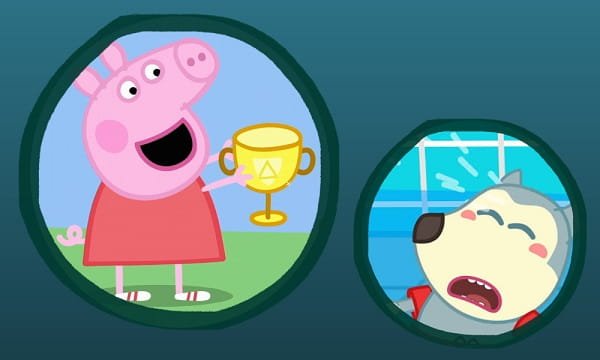
Why Did Hasbro Sue the Makers of Wolfoo?
Hasbro and Astley Baker Davies began the English court proceedings against Vietnamese animation company SConnect in 2022.
The claimants alleged that Wolfoo, a children’s animation about a young wolf and his family, copied several important elements from Peppa Pig. Their original case included copyright infringement, trademark allegations and passing-off claims.
Hasbro argued that similarities between the programmes could cause young viewers to believe that Wolfoo was connected with Peppa Pig or came from the same commercial source. The companies also complained about Wolfoo-related merchandise and references to the Peppa Pig brand.
The High Court’s June 2026 judgment addressed a narrower part of the dispute: whether SConnect copied individual Peppa Pig sound recordings and communicated those recordings to viewers through Wolfoo videos.
What Audio Was Allegedly Copied?
The disputed material included short recordings of words, voices and sound effects originally created for Peppa Pig episodes. One reported example was the familiar expression “Hooray!”
Hasbro’s evidence included spectrograms comparing sounds taken from Peppa Pig with sounds appearing in Wolfoo videos. A spectrogram provides a visual representation of sound frequencies and can help experts determine whether one recording matches another, even when it has been edited or slightly altered.
The court found matches in all 92 English-language Wolfoo videos included in the final sample. The analysis identified at least 1,175 matches across those videos.
Investigators also tested 75 foreign-language Wolfoo videos. Fifty-seven of them contained matching sounds, producing at least 331 confirmed matches. The court noted that these totals were minimum figures because experts did not test every possible match in each video.
How Did SConnect Respond?
SConnect accepted that some earlier Wolfoo productions contained sounds obtained from Peppa Pig videos. However, it argued that an independent contractor had supplied those sounds without the company’s knowledge.
The defendants also maintained that videos produced after the middle of 2020 used original audio created through SConnect’s own recording facilities. They said infringing videos had been removed.
Mr Justice Richard Smith rejected these arguments on the evidence before him. The judge explained that copyright liability for copying did not depend on whether SConnect knew that a contractor had taken the recordings from Peppa Pig.
The court also found evidence that new videos containing copied material continued to appear after 2020. Although SConnect had removed many disputed videos, approximately 70 were allegedly moved to other YouTube channels rather than permanently withdrawn.
What Did the High Court Decide?
The judge granted summary judgment on the sound-recording claim. Summary judgment is issued when the court decides that one side has no realistic prospect of successfully defending a particular claim and a full trial on that issue is unnecessary.
The court entered judgment against the main Vietnamese SConnect company responsible for creating and uploading the Wolfoo videos.
It also found company owner and director Manh Hoang Ta liable for assisting or directing infringements that continued after the lawsuit began. However, the court did not grant summary judgment against him for every earlier act because questions about his prior knowledge could still require further examination.
Why Does the Removal Order Have Global Importance?
SConnect reportedly argued that any removal order should apply only to videos directly examined by experts and should not cover every Wolfoo production. It also objected to an order extending outside the United Kingdom.
The court nevertheless issued relief described as applying across the United Kingdom, the European Union and the 166 members of the World Trade Organization, including Vietnam and the United States. It reportedly ordered all videos featuring Wolfoo removed from platforms such as YouTube, rather than limiting removal to the sampled videos.
This broad approach is significant because Wolfoo content has been distributed internationally in several languages and has attracted billions of online views.
Is the Entire Lawsuit Finished?
Not necessarily. The June judgment decided the sound-recording copyright portion of the claim. Other issues involving visual similarities, trademarks, passing off, financial remedies and legal costs may require further orders or proceedings.
SConnect may also seek permission to challenge parts of the decision or the scope of the injunction. No final publicly confirmed damages amount has been announced.
The Hasbro Peppa Pig Wolfoo lawsuit has nevertheless established that the copied audio was not an isolated accident. The court found extensive and continuing infringement, giving Hasbro a powerful order to protect Peppa Pig content across international online platforms.