 By Bob Paterson
 Yes, magnet fishing is generally legal, but Illinois does not give people an unrestricted right to magnet fish in every river, lake, canal, park, or other body of water. There is no statewide statute that broadly bans the recreational use of a rope and strong magnet to recover metal objects from water. However, property rules, archaeological-resource laws, trespass laws, park regulations, and laws governing found property can determine whether magnet fishing is lawful at a particular location.
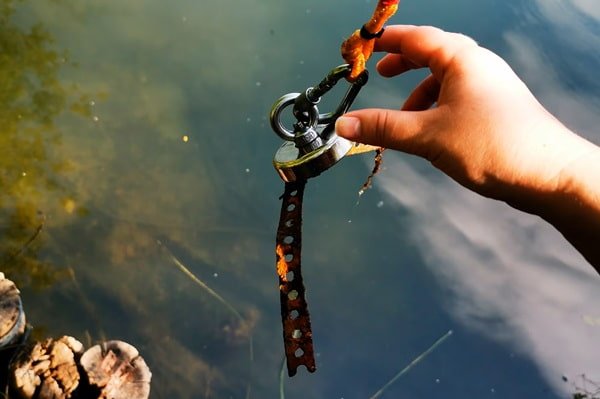
What Does Illinois Law Say About Magnet Fishing?
Illinois does not currently have a specific statute called a “magnet fishing law.” Magnet fishing instead falls under several existing areas of law depending on where the activity occurs and what the person retrieves.
Using a magnet from a lawful location to recover ordinary discarded metal from water is not automatically prohibited under statewide Illinois law.
The situation changes when the water or surrounding land belongs to the Illinois Department of Natural Resources, a municipality, another government agency, or a private property owner.
Historic sites and protected archaeological areas are particularly sensitive because Illinois law restricts the removal of artifacts and archaeological resources from public lands.
Can You Magnet Fish in Illinois State Parks?
Not automatically. Illinois Department of Natural Resources properties are subject to specific rules governing removal of objects and protection of natural and historical resources.
On IDNR-owned, leased, or managed property, visitors generally cannot remove, damage, alter, or take state-owned natural or man-made property without authorization. Collection of archaeological artifacts is also prohibited unless an appropriate permit has been issued.
Illinois already requires permits for metal detecting at state sites where metal detecting is permitted, and some parks prohibit metal detecting entirely because of their historical, archaeological, or environmental importance.
Although throwing a retrieval magnet into water is technically different from operating an electronic metal detector, a magnet fisher should not assume that this distinction creates permission to remove objects from a protected state property.
The safest approach on an IDNR-managed lake, canal, riverfront, or park is to obtain approval from park management before magnet fishing.
Can You Magnet Fish at Historic Sites?
Magnet fishing at historic and archaeological sites can create serious legal problems.
Illinois law protects archaeological and paleontological resources located on public lands. Knowingly exploring for, excavating, possessing, or collecting protected archaeological resources without the required permit is prohibited.
An old metal object recovered from the bottom of a canal or river may be more than ordinary scrap. It could qualify as a historic artifact associated with an archaeological site.
Illinois also prohibits unauthorized collection of artifacts from Department of Natural Resources historic properties.
For example, the Illinois & Michigan Canal is listed on the National Register of Historic Places and is a federal historic landmark. IDNR specifically prohibits metal detecting along that canal and related protected sites.
A magnet fisher who discovers something that appears historically significant should leave the site undisturbed and contact the appropriate land-management authority rather than simply taking the object home.
Is Magnet Fishing on Private Property Legal?
Magnet fishing on private property generally requires the property owner’s permission.
A river or lake may appear publicly accessible while the shoreline, dock, bridge approach, marina, or pond from which the magnet is being thrown is privately owned.
Entering private property without authorization can create a trespass issue even if the water itself is accessible elsewhere.
Permission to fish with an ordinary fishing rod also should not automatically be treated as permission to remove submerged property using a magnet. A property owner may impose different rules concerning retrieval activities.
Can You Magnet Fish From a Bridge?
It depends on the particular bridge and location.
Illinois does not have a statewide rule expressly authorizing magnet fishing from every public bridge. Local governments, transportation authorities, park districts, and property owners can restrict activities on bridges.
A rope, magnet, or recovered object must not interfere with traffic, pedestrians, boats, or navigation.
Dropping a heavy magnet from a busy roadway bridge can also create substantial safety risks. A magnet fisher should obey posted signs and avoid any location where the activity could obstruct the normal use of the bridge or waterway.
What Happens if You Find a Gun While Magnet Fishing?
Finding a firearm should be treated differently from finding ordinary scrap metal.
A gun recovered from a river or lake may have been lost, stolen, discarded after a crime, or otherwise constitute evidence.
The finder should avoid unnecessarily handling, cleaning, unloading, dismantling, or altering the firearm. Local law enforcement should be contacted so officers can take custody of it and determine whether it has been reported stolen or connected with a criminal investigation.
Illinois law provides procedures for law-enforcement agencies dealing with abandoned, lost, discarded, or crime-related firearms, including firearms tracing.
Keeping a recovered gun can also create separate firearm-possession issues depending on the person’s legal eligibility and the type of firearm involved.
Can You Keep Everything You Find?
No, finding an object does not automatically make the finder its legal owner.
Illinois has laws governing lost property. If the owner is known, found property generally must be returned to that person.
For certain property valued at $100 or more when the owner is unknown, Illinois law establishes specific procedures involving an affidavit filed with the circuit court.
Separate rules apply to archaeological artifacts, state property, firearms, potentially stolen property, and other protected objects.
Therefore, recovering an item from underwater should not automatically be treated as establishing ownership.
Do You Need a Fishing License for Magnet Fishing?
Generally, no, an ordinary Illinois sport fishing license is not required merely because someone is magnet fishing.
A fishing license regulates the taking of fish and other aquatic life. Magnet fishing is normally conducted to recover metal objects rather than aquatic animals.
However, if someone uses equipment in a way that unlawfully takes or harms aquatic life, separate Illinois fishing and conservation laws could become relevant.
Frequently Asked Questions
Q1. Can you sell scrap metal recovered while magnet fishing?
Potentially, but only when the person has a lawful right to the recovered material. An object cannot legally become sellable scrap merely because it was found underwater if it belongs to someone else, constitutes protected property, or has archaeological significance.
Q2. What should you do if you pull up ammunition or an explosive device?
The object should not be handled further. Move away from the immediate area and contact law enforcement. Old ammunition, military ordnance, or explosive devices recovered from water can remain dangerous despite appearing heavily rusted.
Q3. Can a city prohibit magnet fishing even though Illinois has no statewide ban?
Yes, local governments and agencies controlling parks, bridges, reservoirs, and other property may impose rules governing recreational activities and removal of objects. Local rules should therefore be checked before magnet fishing at a municipal location.
Q4. Is a metal-detecting permit automatically valid for magnet fishing?
No, the two activities are not necessarily treated identically. A metal-detecting permit authorizes the activity described by that permit and only at the designated site or area. It should not automatically be interpreted as permission to throw magnets into nearby waterways or remove submerged objects.