 By Bob Paterson
Yes, it is generally legal to own a flamethrower at the state level. Illinois does not currently have a specific statewide statute that broadly prohibits ordinary private possession of a flamethrower, nor does current law generally require a FOID card simply because a device is a flamethrower. However, using or carrying one can raise much more serious legal issues involving weapons law, fire-safety regulations, reckless conduct, arson, pyrotechnic licensing, and local ordinances.
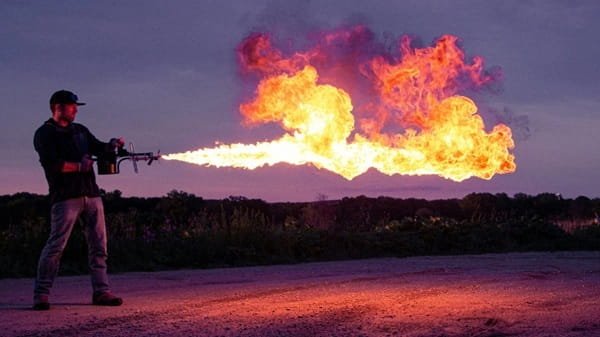
What Does Illinois Law Say About Flamethrowers?
Illinois’s Criminal Code contains extensive restrictions on firearms, machine guns, certain knives, Tasers, explosives, and other dangerous weapons, but it does not currently contain an enacted provision making possession of a flamethrower itself a specific statewide crime.
That makes Illinois different from states that expressly prohibit or specially license flamethrowers.
However, the absence of a specific ownership ban does not mean flamethrowers are unregulated in every situation. A device capable of projecting burning fuel can fall within other criminal or fire-safety laws depending on where it is carried, how it is used, and whether people or property are endangered.
The legal distinction between owning a device and discharging it is therefore particularly important.
Do You Need a FOID Card to Own a Flamethrower?
Under current Illinois law, a FOID card is not specifically required merely for possessing a flamethrower.
Illinois’s Firearm Owner’s Identification Card Act generally requires a FOID card to acquire or possess firearms, ammunition, stun guns, and Tasers. Flamethrowers are not currently included as a separate category in that requirement.
Illinois lawmakers have attempted to change this.
House Bill 19 was introduced during the 2025-2026 General Assembly to require a valid FOID card for acquiring or possessing a flamethrower. The proposal would also impose a 72-hour waiting period before delivery following a sale.
However, the bill has not passed. It was re-referred to the House Rules Committee in March 2025 and has not become Illinois law.
Therefore, those proposed FOID and waiting-period rules should not be described as current requirements.
Can You Use a Flamethrower on Private Property?
Possibly, but owning private property does not create an unrestricted right to discharge a flamethrower.
Illinois criminal law prohibits reckless conduct that causes bodily harm or endangers another person’s safety. A person who uses a flamethrower carelessly near houses, people, vehicles, dry vegetation, or other combustible materials could potentially face criminal consequences even though possession of the device itself was lawful.
Property damage creates additional risks.
Illinois arson law prohibits knowingly damaging another person’s property by fire without consent. More serious charges can apply when buildings are involved or when people suffer injuries.
A person therefore cannot defend dangerous use simply by arguing that Illinois has no statute specifically banning flamethrower ownership.
Can a Flamethrower Be Used for a Public Demonstration?
Illinois imposes special rules when flame effects are used before the public, invited guests, or other audiences.
State pyrotechnic laws define a flame effect broadly to include the ignition or deflagration of flammable gases, liquids, or special materials to create a thermal, physical, visual, or audible effect before an audience.
Such displays generally require supervision by a properly licensed lead pyrotechnic operator and authorization from the appropriate local governmental authority.
These rules can apply to entertainment productions, demonstrations, performances, special events, and other situations in which controlled flames are deliberately produced before an audience.
Therefore, legally owning a flamethrower does not allow someone to bring it to an event and conduct a flame demonstration without considering Illinois pyrotechnic licensing and permit requirements.
Can You Carry a Flamethrower in Public?
Carrying one in public can present considerably greater legal risk than keeping it lawfully stored on private property.
Illinois law prohibits carrying or possessing various dangerous or deadly weapons when the person intends to use them unlawfully against another.
A flamethrower could readily be treated as a dangerous or deadly instrument depending on the circumstances.
For example, carrying one during a confrontation, threatening another person with it, or bringing it somewhere with the intention of using it as a weapon could result in criminal charges even though the device is not specifically banned by name.
Local ordinances and rules governing parks, public facilities, events, and government property may create additional restrictions.
Can You Use a Flamethrower for Self-Defense?
Using a flamethrower against another person would create an extremely serious legal situation.
Illinois self-defense law permits force only when a person reasonably believes that force is necessary to defend against another person’s imminent unlawful force. Deadly or potentially deadly force is subject to a much higher legal standard.
Because projecting burning fuel at a person could cause death, permanent disfigurement, or severe bodily injury, its use would likely be evaluated as potentially deadly force.
The fact that possessing the device may be lawful does not create a special right to use it against someone.
Depending on the circumstances, unlawful use could lead to serious assault, battery, reckless conduct, arson, or other criminal charges.
Do Local Illinois Laws Matter?
Yes, local fire codes and ordinances can be extremely important.
Cities, villages, counties, park districts, and other authorities may regulate open flames, hazardous activities, flammable liquids, public-property use, and fire hazards.
Local fire departments may also impose restrictions when conditions create an unusual wildfire or structural-fire risk.
A person should therefore check both the local fire code and property rules before operating a flamethrower, particularly inside a municipality or near buildings.
Statewide legality of possession does not guarantee that discharge is permitted at a particular location.
Are Flamethrowers Considered Fireworks?
Not simply because they produce flames.
Illinois separately regulates fireworks and pyrotechnic displays. A flamethrower is not automatically classified as an ordinary consumer firework.
However, when a flamethrower or similar device is deliberately used to create a flame effect before an audience, Illinois’s pyrotechnic and flame-effect laws can become relevant.
The legal classification therefore depends partly on how the equipment is being used rather than simply what the owner calls it.
Frequently Asked Questions
Q1. Can an Illinois resident legally buy a flamethrower online?
Illinois currently has no enacted statewide FOID or special flamethrower-purchase requirement merely because the product is a flamethrower. However, the seller may impose its own age, shipping, or delivery requirements, and local law must still be considered.
Q2. Is there a statewide minimum age for owning a flamethrower?
Illinois does not currently establish a specific general minimum ownership age through a dedicated flamethrower statute. Sellers may nevertheless maintain age restrictions, and minors can be subject to other rules governing dangerous equipment and hazardous materials.
Q3. Is building your own flamethrower automatically illegal?
Illinois does not currently make possession unlawful solely because a flamethrower was privately made. However, construction involving hazardous fuel systems can create serious safety and liability issues, and using the device remains subject to criminal, fire-safety, and local laws.
Q4. Can a landlord prohibit a flamethrower even if Illinois law allows ownership?
Yes, a landlord or other property owner can impose restrictions concerning dangerous equipment, fuel storage, open flames, and hazardous activities on property under their control. State law allowing possession does not override a valid lease or property restriction.